
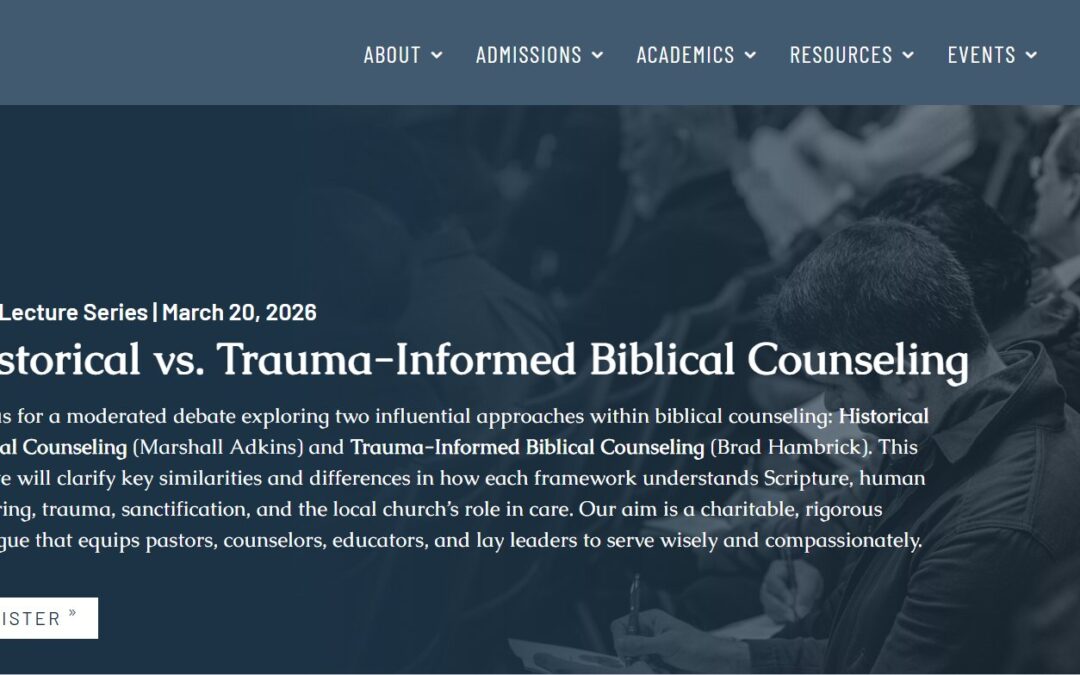
If you have found your way to my blog or social media feeds, you likely know about the Rice Lecture debate on “Historic vs. Trauma-Informed Biblical Counseling” occurring on March 20th. Even if you didn’t already know about this event, I think you’ll be interested.
In this debate, Marshall Adkins and myself will explore three primary questions:
- Sufficiency of Scripture: What is the sufficiency of Scripture and how does it relate to common grace?
- The Role of Extra-Biblical Resources and Secular Psychology: According to what criteria may we successfully identify and incorporate common grace insights into the counseling task?
- Trauma-Informed Counseling: How should biblical counselors approach trauma, and does a trauma-informed approach require an extra-biblical framework?
I am grateful to have been invited to participate in this conversation. I believe it will be a significant event for the biblical counseling movement. That is why I have put together this prayer guide. Anything worth doing should be immersed in prayer.
I would encourage you to pray in the following four ways.
1. Pray for Marshall and Myself
- Pray for our preparation, so that what we share will be a clear and accurate reflection of our respective approaches to biblical counseling.
- Pray that our hearts would be free from rivalry, so that our goal would be to honor God and serve the church well rather than trying to “win” a debate.
- Pray that our time with family and in ministry would be fruitful before and after this event. Debates feel climactic. Pray that nothing about this event distracts us from the day-in-day-out responsibilities God has entrusted to each of us.
2. Pray for the In-Person Audience at DBTS
- Pray that this event would serve their academic training. Marshall and I want to serve the students of DBTS and the community. We want what we say and how we say it to equip each attendee to represent God more faithfully because of our time together.
- Pray that they would have insightful questions. Part of the debate will involve fielding questions from “the counselor in the pew” and the next generation of biblical counselors. Pray that the questions asked foster fruitful and clarifying reflection.
- Pray that this event would foster their spiritual growth. Pray that the dialogue is as devotional as it is academic. Pray that the equipping of believers to use their Bible to care for people through their local church remains forefront in every question we discuss.
3. Pray for the Online Audience *
* The debate will not be available live online. But a video recording will be made available afterwards. Once the videos are available, I will post it on my site so you have access to these videos.
- Pray for charitable listening. Being in the same place (i.e., live audience) shapes how we listen. The distance of online discourse often has an unfortunate impact on how we listen.
- Pray that those who are prone to prefer my approach listen for what is good in what Marshall shares.
- Pray that those who are prone to prefer Marshall’s approach listen for what is good in what I share.
- Pray that whatever needs to be refined in both what I or Marshall share is conveyed with a balance of truth and love.
- Pray for mutually-honoring follow up dialogue. Pray that God would be honored in the follow up dialogue. Pray that the fruit of our debate is more light than heat.
- Pray for fruitful, personal reflection. Pray that each online listener asks, “Where and how do I need to grow in my approach to counseling?” Pray that Marshall and I would model what it sounds like to engage important questions with this posture.
4. Pray for the Biblical Counseling Movement
- Pray that we could openly celebrate where we have common ground. My personal hope is that this debate reveals that while our differences are real, our common ground is greater than the recent discourse would imply.
- Pray that this time clarifies where there are differences. Where differences exist, there is benefit to naming and articulating those differences. Pray that God would give us accurate, clear, charitable ways to articulate our differences.
- Pray that we would maintain a steadfast confidence in God’s ability to guide his church. We can all be prone to think the future of the church stands or falls on what is most important to us. God has assured us this is not the case (Matt. 16:18). May this truth give rest to our souls.
- Pray John 17:20-26 would pervade everything the biblical counseling movement does.
John 17: 20-26, “I do not ask for these only, but also for those who will believe in me through their word, that they may all be one, just as you, Father, are in me, and I in you, that they also may be in us, so that the world may believe that you have sent me. The glory that you have given me I have given to them, that they may be one even as we are one, I in them and you in me, that they may become perfectly one, so that the world may know that you sent me and loved them even as you loved me. Father, I desire that they also, whom you have given me, may be with me where I am, to see my glory that you have given me because you loved me before the foundation of the world. O righteous Father, even though the world does not know you, I know you, and these know that you have sent me. I made known to them your name, and I will continue to make it known, that the love with which you have loved me may be in them, and I in them.”
Thank you for praying!