
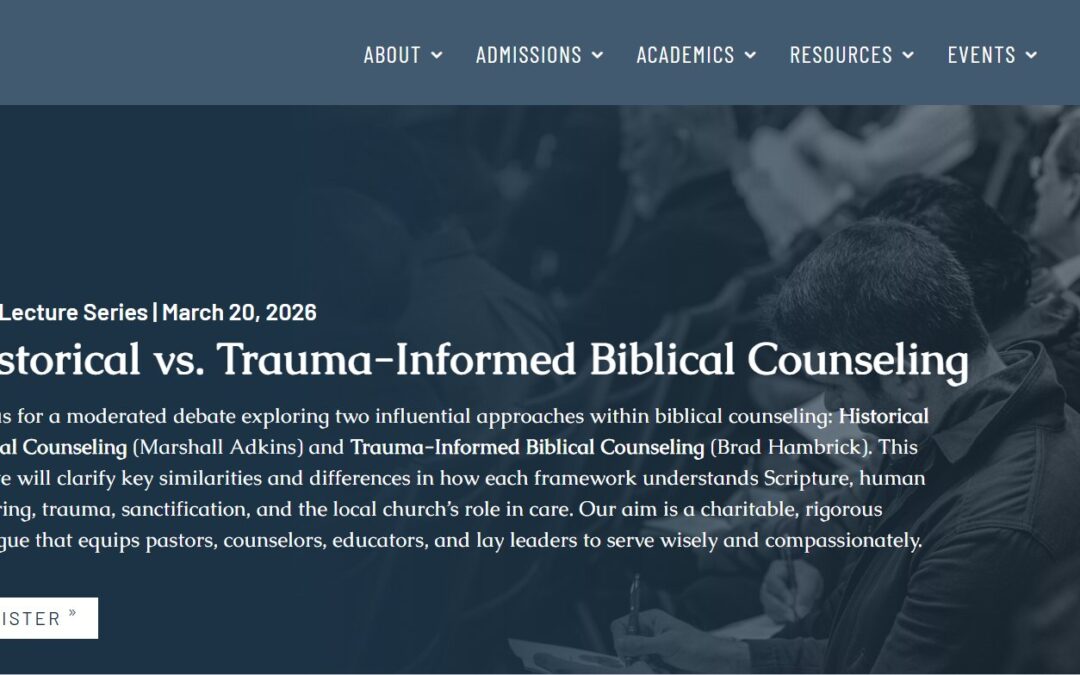
It has been almost a month since the Rice Lecture Series debate on biblical counseling at Detroit Baptist Theological Seminary (DBTS). With a bit of time having passed, it seemed like a fruitful exercise to reflect on this experience.
A Historic Event
What stands out most is that this was a historic event. I’ve been in the biblical counseling movement for 25 years now (yeah, I’m old), if you count the time I spent as an MDiv student studying counseling. During that time, I’ve studied the history of our movement. To my knowledge, this was the first time we have openly discussed our differences. Up until this point, any discussion of differences was either done:
-
- Privately, between individuals or small groups during an event like a conference, or
- Online (social media, blogs, videos, etc.), where concerns are raised with minimal opportunity for direct conversation.
As our movement continues to grow, these types of conversations are more important. It was an honor to be a part of this event, and I appreciate the courage of DBTS to host it.
A Listener’s Guide
If you have not yet had the opportunity to listen, the video of the debate can be found here (https://old.bradhambrick.com/dbts2026/). It is more than three hours long, so it may be helpful if you listen to the debate in parts. The debate naturally divides into four sections.
-
- Brief Introduction – First 5 minutes
- Segment One – Begins around the 5:40 mark (lasts about 70 minutes)
- Segment Two – Begins around the 1:15 mark (lasts just over 45 minutes)
- Segment Three – Begins around the 2:00 mark (lasts just under 45 minutes)
- Segment Four – Begins around the 2:45 mark (lasts about 30 minutes)
As you watch, it may help you to realize this was both my and Dr. Adkins first time being part of a debate. If you are an experienced debater, you will undoubtedly hear and observe parts of our presentation that demonstrate our inexperience. Please listen with charity. After having been a part of this debate, I have far greater appreciation for the preparation and endurance required for this style of interaction.
A Collection of Responses
Since the debate video was posted online, I have tried to keep up the reviews of the debate. If you are interested in comparing your thoughts with those of others, you can do so by reviewing the links below.
-
- Cody Bockelkamp offers his thoughts here. From what I have read of Cody’s work, he does not fully align with either Dr. Adkins or myself and strives to provide an even-handed evaluation.
- Tim Allchin reviews the debate within the larger context of disagreements within biblical counseling. Dr. Allchin grew up in the ACBC tradition but also strives to provide an even-handed evaluation. You can read his thoughts here.
- Allchin plans to do a 5-part series reflecting on the debate. Part two is now available. You can follow him to see each of these as they are released.
- Richard Byrne offers the perspective of someone who attended the live event and favors the ACBC position. You can read his thoughts here.
- Colin McCulloch reflects on the recent prompt for this debate and the implications of this prompt. I am not sure where Dr. McColloch falls on the ACBC to CIBC spectrum. You can read his thoughts here.
- Dr. McCulloch wrote a second piece discussing the importance of giving proper weight to the term helpful versus necessary and the implications for both sides of the debate. You can read his thoughts here.
- Bob Kellemen reflects on the focus within the debate on relief-oriented strategies that frequently recurred. Dr. Kellemen, while not holding the CIBC position, it is my sense that he is closer to that position than an ACBC approach. You can read his thoughts here.
- Marshall Adkins sat down with Heath Lambert to discuss their perspective on the debate here. Obviously, they prefer the ACBC position.
- Leroy Hill provided an in-depth discource analysis evaluating the tactics / rhetorical approaches in the debate. You can read his thoughts here.
- Margy Hill wrote a piece on the debate looking at the common group that exists between Dr. Adkins and myself. You can read her thoughts here.
I am choosing not to link to all the bite-sized comments on social media regarding the debate. But if I missed an article link reflection on the debate, please let me know and I’ll add it to this list.
A Statistical Analysis
I put the manuscript of the DBTS debate into AI and asked it several statistically oriented questions. I thought that might be an effective way to gain some objective analysis. Here is what AI determined.
-
- How many references to Scripture did Dr. Adkins and Dr. Hambrick make in their respective presentations?
- Adkins referred to 23 passages of Scripture.
- Hambrick referred to 22 passages of Scripture.
- How much time did Dr. Adkins and Dr. Hambrick spend directly teaching from passages of Scripture and what percentage of their speaking time did this comprise?
- Adkins spent 6 of his 54 speaking minutes teaching from Scripture (6%).
- Hambrick spent 11 of his 52 speaking minutes teaching from Scripture (21%).
- How much of their respective speaking time did Dr. Adkins and Dr. Hambrick spend critiquing the other person’s position? If you subtract that percentage from 100%, how much time each of us spent giving a positive explanation of our approach.
- Adkins spent 18 of his 54 minutes speaking critique (33%).
- Hambrick spent 6 of his 52 minutes speaking in critique (15%).
- How many theologians did Dr. Adkins and Dr. Hambrick cite during their presentation time?
- Adkins referred to 22 theologians: including David Powlison, Jay Adams, Lou Priolo, and Heath Lambert.
- Hambrick referred to 26 theologians: including John Frame, Millard Erickson, Louis Berkhof, J.I. Packer; Wayne Grudem, David Powlison, Jay Adams, and Heath Lambert.
- How many references to Scripture did Dr. Adkins and Dr. Hambrick make in their respective presentations?
Obviously, there are limits to the quality of analysis AI can provide. But I tried to ask questions tailored to the type of assessment AI is best suited to provide. As you listen to the debate, these metrics may help you weigh what you hear.
10 Personal Reflections
With that introduction, I’ll offer my thoughts. I made a list of ten reflections and will provide brief commentary to each.
1. Conversations like this are valuable, should continue, and should be public. I don’t think anyone (me included) expected Dr. Adkins or me to change the other’s views. Conversations like this are primarily for the audience (you) to better understand the areas of overlap and differences that exist within biblical counseling. To do so, you need access to full discourses. For instance, when Ed Welch wrote in his Spring 2025 letter to the editor in the JBSC that he felt misrepresented by Francine Tan regarding what he presented at an ACBC Colloquium, you do not have the information necessary to weigh this concern. A year later, ACBC has only apologized for publishing what Dr. Welch initially meant to be a private letter. No response has been given to the substance of his concerns. If this discourse were public, like the DBTS debate, you could weigh this concern for yourself and not be left waiting.
2. DBTS was gracious and fair host who did not seek to influence the debate at the event. Admittedly, I was a bit worried when in the weeks leading up to the debate, the moderator and ACBC released multiple podcasts discussing why my position (at least how they perceive and portray my position) was wrong and even potentially illegal.
-
- Podcast One: “Suffering and Trauma-Informed Counseling”
- Podcast Two: “Bessel van der Kolk’s Approach to Trauma”
- Podcast Three: “Complex Trauma”
- Podcast Four: “Is Informed Therapy Even Legal?”
But the moderator did not influence the debate once it got started. My worries proved unfounded. I was grateful for that. In the end, the ACBC podcasts provided illustrative material for the debate. I include the links to their podcasts so that you can assess whether I represented them fairly in my remarks during the debate.
3. I was glad to publicly affirm many parts of Dr. Adkins’ presentation. I was disappointed, that other than affirming that I am a brother in Christ who has good intentions, Dr. Adkins could not find anything else I said that he could affirm. Unfortunately, I believe this is indicative of the politicization of biblical counseling. I disagree with the notion that the differences within biblical counseling are akin to modern political party divides. They are more like differences between evangelical denominations. But they are not such that we should reject, out of hand, anything the other “party” says or does.
4. I was most surprised and disappointed at response to breathing exercises. The number of times basic calming practices, like controlled breathing, were portrayed as firmly “outside biblical counseling” was shocking. The notion that a counselor should refer a counselee to a medical doctor to gain basic skills for calming their body seems unnecessary and unkind (at best). I did not realize ACBC took this strong of a stance. Historically, I have not found that to be the case, and I fear this is another fruit of “historic biblical counseling” hardening as they take a politicized stance against anything coming from clinically-informed or trauma-informed counselors.
5. Does anyone organization own the term “biblical counseling”? I think this question may be where the primary topics of the debate got muddied. Before the debate, when I heard the claim that I was not a “historic biblical counselor,” I thought they merely meant I was not ACBC (formerly NANC). I am not. I have never claimed to be. However, I don’t think you have to be ACBC to be a biblical counselor. Biblical counseling existed before ACBC. Biblical counseling did not begin in 1970 with the publication of Competent to Counsel. It seems odd to call something “historic” that began at the same time as Nike, Post-It Notes, email, and Rubik’s cubes (all things that originated around 1970).
6. I was disappointed that when I directly asked, “What am I doing that is so dangerous?” and that I got no direct answer. During my presentation, I tried to provide multiple tangible examples for critique. I added more examples in responses to Dr. Adkins’ questions. When I asked, on multiple occasions, what made my examples dangerous, he did not give me a response. You can decide whether these things are dangerous: breathing exercises, having the standing to be an expert witness for Christian parents going through custody battles, using career inventories for students exploring career possibilities, or understanding professional counseling ethics well enough to avoid fines related to counseling LGBTQ matters. These are examples I gave and asked, “How is this dangerous?”
7. I was disappointed that when I directly asked, “How is what I do different from a concrete example from ACBC conference speakers and blog articles?” and I got no answer. For the record, I was not being critical of the primary example I gave regarding the use of the Power and Control wheel and the Duluth model. As I said at the debate, I thought the example was a legitimate use of common grace insights to bring greater pixelation to biblical categories. If my work merits the degree of public rebuke it has received, it seems like there would be an immediately clear difference from work ACBC has affirmed multiple times in multiple locations over a 5-year span (original address in 2020 at ACBC annual conference which was republished manuscript in November 2025 on the ACBC blog).
8. I was disappointed that the example of Jay Adams’ case study regarding a father raping his daughter could not be acknowledged as an unfaithful approach to Scripture and is still being defended by ACBC counselors. This case study is not a stand-alone example. Jay Adams published another case study that largely ignores the reports of physical abuse against a wife, instead focusing on her need to forgive her husband’s affair and acknowledge her contributing faults (The Christian Counselor’s Casebook). Why are breathing exercises dangerous and this counsel okay? Examples like this are not just from the early work of ACBC. The ACBC podcast released just weeks before the debate says multiples times that trauma victims should be called to repent of their night terrors. These examples are representative of why I believe adjectives like trauma-informed or clinically-informed are beneficial. When I say I am a biblical counselor, I want people to know I am not the kind of counselor who would care for people in this way. I believe that counsel is an inaccurate representation of God and Scripture.
9. I was disappointed that sympathetic case studies and confronting false portrayals of my work is viewed as an “emotional” appeal. It is not manipulative to present sympathetic cases sympathetically. Yes, when my work was misrepresented, I read from direct excerpts from my books that refuted Dr. Adkins’ claims, and I made free samples of my books available by dropping them on the table at the front of the podium. It is odd that the manner in which false claims are confronted gets more attention than an ACBC counselor making claims that, if he had read or watched the material he was criticizing, were clearly false. In an academic debate between two men with terminal degrees the falseness of claims should get more attention than the sound a book being dropped on a table.
-
- Again, this is why I am glad the debate was public. You can watch (from 2:36 to 2:45, 9 minutes of Dr. Adkins remarks that I believe to be false and my response) and determine the degree of self-control (or lack thereof) demonstrated in my actions. Decide for yourself whether I was sinfully out of control or whether this is another false claim about my work.
10. This debate is a good opportunity to compare scriptural exegesis with personal exegesis; do we as biblical counselors strive to interpret people as accurately as we interpret the Bible? This was a major premise of my argument throughout the debate. I don’t think people like me and Dr. Adkins usually disagree over the interpretation of Scripture. Instead, we disagree over the interpretation of people, their experience, and, therefore, what it looks like to be an ambassador of God’s Word. When I hear of someone having night terrors after trauma, I interpret the person as a sufferer in need of comfort. Evidently, in ACBC, this person is culpable for the lack of faith their fearful dreams demonstrate and needs to repent. Because we interpret the person and their situation differently, we go to different places in Scripture to represent God’s care for them.
Final Question
That brings me to my final question: After listening to the debate, if you had a loved one who suffered intensely, who do you trust more as a counselor? Who do you think would represent God’s care best? Who do you think would utilize God’s Word most skillfully? This is the ultimate question of the debate. I think if you listen to the debate, you will gain what you need to arrive at a conclusion regarding what kind of care you want for your loved ones and, if you are a counselor, what kind of care you would want to offer in God’s name.