
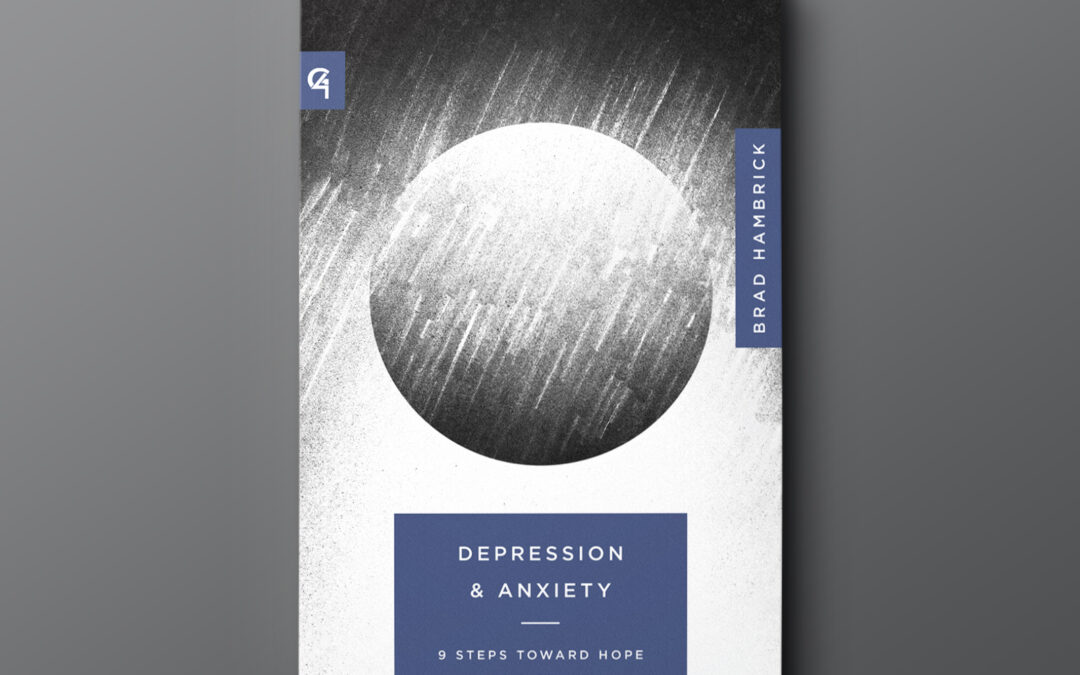
 This article is an excerpt from Depression and Anxiety. The book is meant to be used in tandem with participation in a G4 group. But they can also be used in conjunction with a counseling or mentoring relationship. We strongly encourage you not to take this journey alone!
.
This appendix is written for those coming alongside a friend who may be considering self-harm. In a G4 group that is focused on depression-anxiety, it is likely that at some point, a member will begin to despair to a degree that they consider self-harm. We want you to have a plan for responding to that member.
If at any point when you are unsure what to do next, you can call 988. This is the national Suicide and Crisis Lifeline. You will be connected with a trained professional who can talk with you and your friend (if they are willing) to assess the situation and identify possible next steps.[1]
When a friend is considering self-harm, your goal is not to resolve the totality of what is leading them to despair. Your goal is more modest: You merely want to help them navigate the immediacy and intensity of their situation. Usually, if you can help your friend commit to avoiding self-harm over the next one to three days (24 to 72 hours), their sense of despair will have subsided significantly.
As you talk, remain calm, maintain pleasant facial expressions, talk slowly, and ask basic questions. When you remain regulated, it will help your friend begin to regulate their own emotions. As long as your friend is with you or talking to you, they are safe. Allow that awareness to help de-escalate your own emotions.
Start with the following basic questions:
- Have you thought about harming yourself? If you are unsure of your friend’s answer to this question, ask. Asking won’t prompt an action your friend wasn’t considering, but it may open a conversation they were afraid to broach. That’s a good thing.
- Do you have a plan? Do you have access to the things necessary to accomplish your plan? If they have a plan, there is more risk than if they do not. The more lethal and accessible their plan, the higher the risk.
- When are you going to be alone in the coming days/weeks? Do you plan to use drugs/alcohol any time soon? What adds to your despair? Isolation is a near universal prerequisite for suicide. Drugs and alcohol lower judgment and increase impulsivity. Events that add to despair might include fighting with parents, learning that my ex is on a date with someone else, or receiving a failing test grade. This set of questions identifies high risk times.
- Who in your life can serve as caring support for accountability and encouragement? You don’t want to be the only caring person that knows about your friend’s thoughts of self-harm. You want to encourage your friend to reach out to these people for additional support.
- What obstacle would you need to overcome for life to be worth living? What has kept you from harming yourself? There are reasons your friend has not followed through on their thoughts of self-harm. It might be, “I couldn’t do that to my children/parents,” or “I still have dreams I want to accomplish.” The obstacle might be, “I need to find a way to stop the foreclosure on my home,” or “I would have to find a way to tell my wife about my affair.”
If your friend pulls away from the conversation, that is a time to call 988 for guidance. If that call is needed, asking questions like these allows you to gain as much information as possible so that you can share with the social worker on the hotline and receive better guidance about what to do next.
If your friend engages in the conversation, you can now help them outline wise decisions for next actions. You can take out a piece of paper and write out what you’ve learned in an informal life agreement. As a friend, family member, pastor, or G4 facilitator, you don’t need a life agreement that looks and reads like a formal contract. Some people fear liability if this type of document doesn’t look like a legal contract. That fear is not accurate. You are only responsible for taking reasonable steps based on what you know. Typed legalese on a preprinted form doesn’t change your liability. Again, if you’re unsure, call 988.
You might say something like this as you write out the information from your friend’s responses to the questions above, “Can I summarize our conversation and sketch out what I’ve heard you say?”
I am feeling despair because [obstacle from question #5].
I don’t want to act on that despair because [reason for living from question #5].
Because [object from question #2] could tempt me toward self-harm, I need to [ways of removing access to the means of self-harm].
There are people who care about me [list from question #4]. I need to talk with them about how I’m feeling. I will call them today.
In the coming week, [times of danger from question #3] I need to make sure I’m not alone [plan to be with someone who cares about me during these times].
If I start to feel overwhelmed and compelled to hurt myself, I will call 988 or [names from question #4 and number].
I am willing to do these things because [repeat reason for living from question #5].
Even though I feel overwhelmed, I want to live and that’s why these are the steps I need to take.
Hearing this type of summary crafted from their own words is more compelling than a fill-in-the-blank form. Something that is handwritten is more personal than something preprinted. It conveys that you view your friend as a person to be cared for rather than a liability to be managed. That is hope-giving and dignifying.
After walking them through your summary and allowing them to read what you wrote, ask, “Is this something you are willing to commit to? [Listen] Is there anything we left out? [Listen]” Then pray with them.
If you are feeling uncertain, ask, “How would you feel if we had someone else help us think this through? 988 is a lifeline where we could talk with someone together to make sure we aren’t overlooking anything important.”
The reality is you cannot force someone to get help. Law enforcement can involuntarily commit someone, usually for up to 72 hours, if they are an imminent threat to themselves. If someone is alone and you are unsure about their well-being, you can call local law enforcement to do a wellness check.
When you have done these things, you have done the things within your power to care for them. Then remember to pray for them. You can give people an outlet for communication, and you can help them identify wise options. You cannot change their heart. You cannot make the dark lies of their despair unconvincing. That is between them and God.
Most often, the worst-case scenario of a suicide attempt will not be the outcome. Your friend is better off because you are there to talk with them during their despair. Be faithful. Err on the side of caution. Reach out for additional help when you’re uncertain. But do not hold yourself responsible for their choices.
.
[1] If you are outside the United States, a list of comparable crisis hotline numbers for other countries can be found at https://blog.opencounseling.com/suicide-hotlines/ or www.iasp.info/suicidalthoughts.